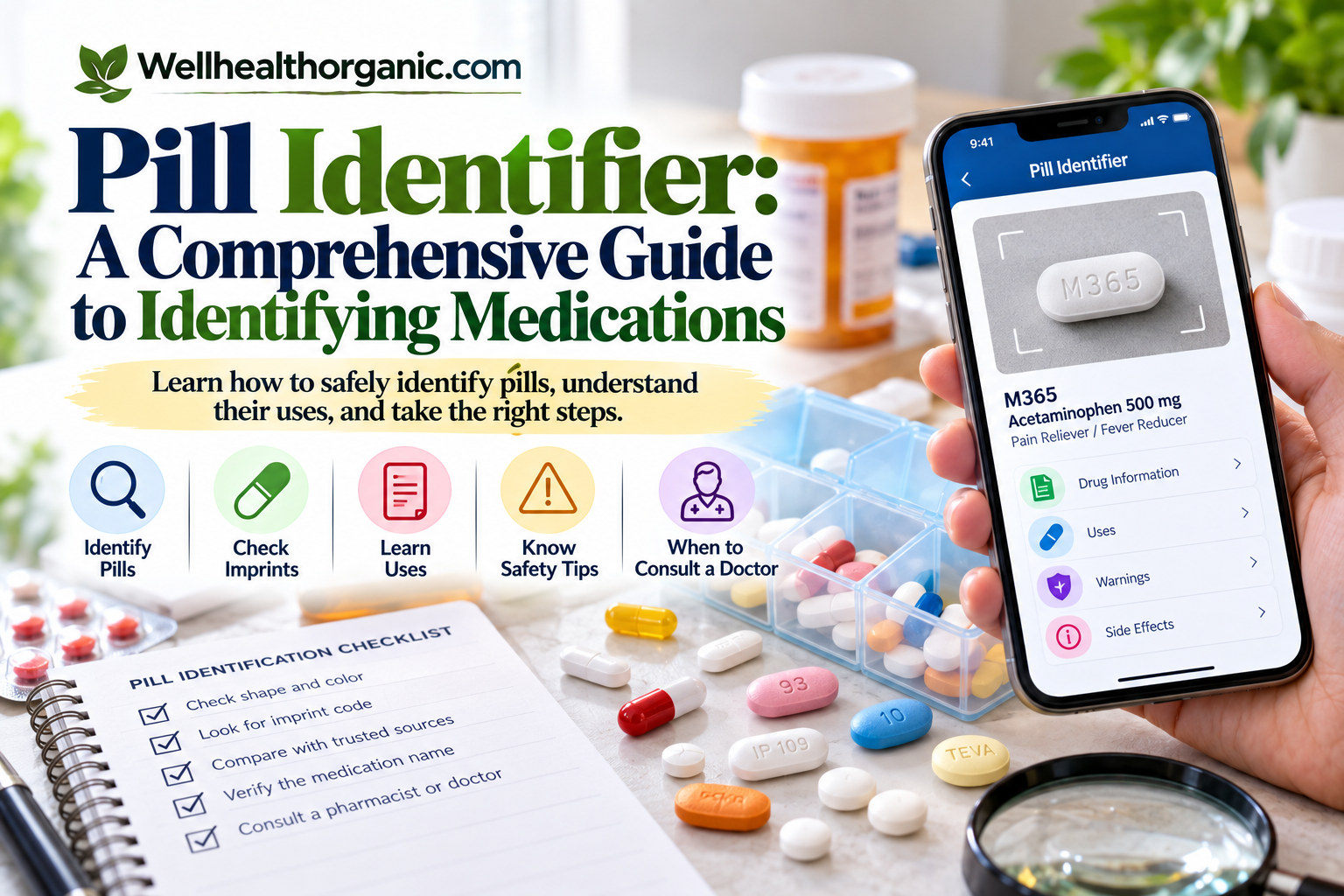
Finding an unfamiliar pill can be confusing. Perhaps a tablet fell out of its original bottle, you received medication that looks different from your previous refill, or you simply want to verify that the medication you received matches your prescription.
A pill identifier can help narrow down possible medications using characteristics such as the pill’s imprint, color, shape, and size. However, identifying medication from appearance alone has important limitations.
You should never take an unknown pill simply because an online pill identification tool produces a possible match. If you cannot confidently verify a medication, keep it separate and ask a pharmacist or another qualified healthcare professional to identify it.
This guide explains how pill identifiers work, what information you need, how to search for a pill by imprint or appearance, why pills sometimes look different, and what to do when a medication cannot be identified.
What Is a Pill Identifier?
A pill identifier is a tool or reference that helps identify medications according to their physical characteristics.
Depending on the tool, you may be able to search using:
- Letters or numbers printed on the pill
- Imprint code
- Color
- Shape
- Size
- Score marks
- Other visible characteristics
The tool then compares those characteristics with medication information in its database and displays possible matches.
What Is a Pill Imprint?
An imprint is a combination of letters, numbers, symbols, or markings found on a tablet or capsule.
For many medications, the imprint is one of the most useful characteristics for identification.
An imprint might look something like:
- A 123
- 10
- ABC 25
- M 50
These are only examples of how imprint patterns may appear and are not intended to identify a particular medication.
When using a pill identifier, enter the imprint exactly as you can read it and check both sides of the medication.
Why Is the Imprint So Important?
Color and shape alone are generally insufficient for reliable pill identification.
Many unrelated medications can be:
- White
- Round
- Oval
- Blue
- Pink
- Capsule-shaped
An imprint provides additional information that can substantially narrow the possible matches.
Even then, an online match should be verified before an unknown medication is taken.
How to Identify a Pill
If you have an unknown tablet or capsule, start by examining it carefully in good lighting.
Do not taste, chew, crush, or swallow an unidentified pill in an attempt to determine what it is.
Step 1: Check Both Sides of the Pill
Look for:
- Letters
- Numbers
- Logos
- Symbols
- Score lines
Write down everything exactly as it appears.
Step 2: Identify the Color
Record the closest obvious color, such as:
- White
- Blue
- Green
- Yellow
- Orange
- Red
- Pink
- Brown
- Purple
Some capsules contain two colors, so record both if appropriate.
Step 3: Identify the Shape
Common pill shapes include:
- Round
- Oval
- Oblong
- Capsule-shaped
- Square
- Rectangle
- Triangle
- Diamond
Step 4: Estimate or Measure the Size
If the identification tool supports pill size, measure the tablet or capsule rather than relying entirely on memory or photographs.
Size can help distinguish medications that otherwise look similar.
Step 5: Search a Reliable Pill Identifier
Enter the imprint and any additional characteristics into a reputable medication-identification resource.
Start with the imprint whenever possible because it is generally more useful than color alone.
Step 6: Compare the Results Carefully
Compare potential matches with the actual pill.
Check:
- Exact imprint
- Imprint placement
- Color
- Shape
- Size
- Score marks
- Whether markings appear on one or both sides
If important characteristics do not match, do not assume it is the same medication.
Step 7: Verify the Medication
If there is any uncertainty, ask a pharmacist to verify the medication before taking it.
This is especially important when the pill was found outside its original packaging.
Can You Identify a Pill by Color?
Color can help narrow a search, but it should not be used by itself to identify medication.
Hundreds of medications can share similar colors.
Color can also vary between manufacturers, generic versions, formulations, and even photographs displayed under different lighting.
For example, searching for a “small white round pill” could produce many unrelated possibilities.
An imprint is generally much more useful.
Can You Identify a Pill by Shape?
Shape is another useful secondary characteristic but usually cannot uniquely identify a medication.
Many tablets share common shapes such as round, oval, or oblong.
Use shape together with the imprint, color, size, and other distinguishing features.
Can You Identify a Pill Without an Imprint?
A pill without an identifiable imprint can be much more difficult to identify accurately.
Depending on the product and jurisdiction, it could potentially be:
- A dietary supplement
- A vitamin
- An herbal product
- A foreign medication
- A compounded medication
- A product not represented in the identification database
- A counterfeit or illicitly manufactured pill
Do not guess based on color and shape alone.
If the pill cannot be reliably identified, do not take it. A pharmacist may be able to provide additional assistance.
Why Pill Identification Matters
Correct medication identification can help prevent several potentially serious problems.
Preventing Medication Mix-Ups
Medications stored outside their original containers can become mixed together.
A pill identifier can help investigate a possible mix-up, although uncertain medications should still be professionally verified.
Checking an Unexpected Appearance
A prescription may occasionally look different after a refill.
This does not necessarily mean the pharmacy made a mistake.
The pharmacy may have dispensed an equivalent medication from a different manufacturer.
However, if the appearance changes unexpectedly, verifying it with the pharmacy is appropriate.
Reducing Accidental Medication Errors
Taking the wrong medication or strength can potentially result in serious adverse effects.
Keeping medications correctly labeled and verifying unexpected pills can reduce this risk.
Why Does My Prescription Pill Look Different?
There are several reasons a prescription may look different from a previous refill.
Possible explanations include:
- A different generic manufacturer
- A change from brand-name to generic medication
- A change from one generic manufacturer to another
- A different strength or formulation
- A legitimate change in product appearance
- A dispensing error
Do not assume that a different-looking pill is incorrect, but do not assume it is correct either.
If you did not expect the change, check the prescription label and contact the pharmacy before taking the medication.
Generic Pills vs. Brand-Name Pills
A generic medication may have a different color, shape, or imprint from the brand-name version.
Generic versions produced by different manufacturers can also look different from one another.
This is one reason identifying a medication solely by remembering its color can be unreliable.
Can Two Pills Look Almost Identical?
Yes.
Different medications can share very similar physical characteristics.
Two tablets might both be small, round, and white while containing completely different active ingredients or strengths.
The imprint and original labeled packaging are therefore particularly important.
What Information Can a Pill Identifier Provide?
Depending on the database and medication, a pill identification result may include information such as:
- Medication name
- Generic or brand name
- Strength
- Active ingredient
- Manufacturer or labeler information
- Physical description
- Drug class
After identifying a medication, use an appropriate medication reference or healthcare professional for information about uses, warnings, side effects, interactions, and dosing.
A Pill Identifier Does Not Tell You Whether You Should Take the Medication
This distinction is extremely important.
Identifying a pill does not establish that:
- It was prescribed for you
- It is the correct dose for you
- It is safe with your other medications
- It has been stored properly
- It has not expired
- It is authentic
- You should take it
Never take someone else’s prescription medication simply because you know what the pill contains.
Can Pill Identifiers Detect Counterfeit Pills?
No. A pill identifier cannot reliably prove that a pill is authentic.
Counterfeit pills can be manufactured to resemble legitimate prescription medications, including copying their:
- Color
- Shape
- Size
- Logos
- Imprint markings
A visual match therefore does not guarantee that a pill contains the medication shown in a database.
The Risk of Counterfeit Pills
Counterfeit medications are particularly dangerous because their actual ingredients and strength may be unknown.
Illicitly manufactured pills can sometimes contain highly potent substances such as fentanyl or other unexpected drugs.
A pill obtained outside a licensed pharmacy or other legitimate medication supply chain should not be considered safe merely because it resembles a recognized prescription medication.
Can You Identify Fentanyl by Looking at a Pill?
No.
You cannot reliably determine whether an illicit or counterfeit pill contains fentanyl simply by looking at its color, shape, or markings.
Counterfeit pills may be deliberately manufactured to resemble legitimate prescription medications.
Do not take an unknown pill based on visual identification.
What Should You Do With an Unknown Pill?
If you find a pill and do not know what it is:
- Do not swallow it.
- Keep it away from children and pets.
- Do not mix it with your regular medications.
- Check its imprint and other physical characteristics.
- Use a reputable pill-identification resource if appropriate.
- Ask a pharmacist if you cannot confidently identify it.
- Dispose of unwanted medication using an appropriate medication-disposal method.
What If Someone Already Swallowed an Unknown Pill?
If someone has swallowed an unidentified medication, do not wait for an online pill identifier before seeking help when poisoning or overdose is possible.
Contact an appropriate poison-information service, healthcare professional, or emergency medical service according to the situation.
Be prepared to provide information such as:
- The person’s age
- Approximate weight
- Symptoms
- When the pill was taken
- How many pills may have been taken
- The pill’s imprint and appearance
- Other medications or substances involved
If possible, keep the pill or its packaging available for healthcare professionals to examine.
Signs of a Possible Medication Overdose
Symptoms vary depending on the substance involved.
Potentially serious warning signs can include:
- Difficulty breathing
- Very slow or abnormal breathing
- Loss of consciousness
- Inability to wake
- Seizures
- Severe confusion
- Blue, gray, or unusually pale skin or lips
- Severe agitation
- Abnormal heart rhythm or severe chest symptoms
Seek emergency medical assistance for severe or life-threatening symptoms.
Do Not Induce Vomiting Unless Instructed
If someone swallows an unknown pill, do not automatically induce vomiting.
Doing so can sometimes cause additional harm.
Follow instructions from an appropriate poison-information service or healthcare professional.
Identifying Broken or Damaged Pills
A broken tablet can be difficult or impossible to identify if part of the imprint is missing.
Do not assume an identification based on a partial imprint unless the medication can be reliably verified.
If the pill came from your prescription bottle and you are uncertain about it, contact the dispensing pharmacy.
Identifying Foreign Medications
Medication appearance and labeling practices differ between countries.
A pill-identification database designed for one country may not contain medications manufactured or distributed elsewhere.
If you need to identify medication obtained in another country, consult a pharmacist or healthcare professional familiar with the product or use an appropriate official medication database for that jurisdiction.
Can You Identify Vitamins and Supplements With a Pill Identifier?
Sometimes, but not reliably in every case.
Dietary supplements can be more difficult to identify from appearance because labeling and imprint requirements can differ from those for prescription medications.
If a vitamin or supplement has been removed from its original packaging and cannot be confidently identified, replacing it with a properly labeled product may be safer than guessing.
Can You Identify Veterinary Medication?
General human pill-identification databases may not adequately cover veterinary medications.
If you need to identify medication prescribed for an animal, contact the prescribing veterinarian or dispensing veterinary pharmacy.
Can You Identify a Pill From a Photo?
A photograph may help show an imprint, shape, or color, but a photo alone has limitations.
Lighting can alter color, perspective can distort size, and small imprint details may be difficult to read.
A photo also cannot establish that a pill is authentic or reveal its chemical contents.
Use photographs as supporting information rather than definitive proof of a medication’s identity.
Can AI Identify a Pill From a Picture?
Image-recognition technology may be able to suggest possible matches based on visible characteristics, but it should not be considered definitive medication identification.
AI can misread imprints, colors, shapes, or damaged tablets.
More importantly, an image cannot reliably distinguish an authentic prescription medication from a visually convincing counterfeit.
Do not take an unknown medication solely because an AI system identifies it from a photograph.
Can a Pharmacist Identify a Pill?
A pharmacist is an excellent resource when you are uncertain about medication identification.
Provide as much information as possible, including:
- The pill itself
- Original packaging if available
- Prescription bottle
- Where the pill came from
- Any readable imprint
The pharmacist can compare the medication with appropriate professional information and determine the safest next step.
Can a Pill Identifier Check Drug Interactions?
Pill identification and drug-interaction checking are different tasks.
First, the medication must be correctly identified.
Then its potential interactions with other medications, supplements, foods, alcohol, or medical conditions can be evaluated using appropriate professional resources.
A pharmacist or healthcare professional can help review your complete medication list.
Medication Allergies and Pill Identification
Correctly identifying medication can help determine its active ingredients, but you should not use appearance alone to determine whether a medication is safe when you have a known drug allergy.
Check the prescription label and medication information and discuss concerns with a pharmacist or healthcare professional.
Seek emergency assistance for symptoms of a severe allergic reaction, particularly difficulty breathing or significant swelling of the face, lips, tongue, or throat.
Never Share Prescription Medication
A medication that is safe and appropriate for one person may be dangerous for someone else.
Differences in medical history, age, allergies, pregnancy, kidney or liver function, drug interactions, and prescribed dose can substantially affect medication safety.
Never share prescription medication with another person simply because they appear to have similar symptoms.
How to Prevent Pill Identification Problems
The safest strategy is to prevent medications from becoming unidentified in the first place.
Helpful practices include:
- Keep medications in their original labeled containers whenever practical.
- Do not combine unrelated medications in the same bottle.
- Maintain an updated medication list.
- Keep medications away from children and pets.
- Use pill organizers carefully.
- Check medication labels before taking each dose.
- Ask your pharmacist about unexpected changes in appearance.
Using a Pill Organizer Safely
Pill organizers can make medication schedules easier to manage, but once medications are removed from their labeled containers, identification can become more difficult.
Before filling an organizer:
- Check each medication label.
- Verify the correct dose.
- Use adequate lighting.
- Avoid distractions.
- Keep an updated medication list nearby.
Some medications also require special storage and may not be appropriate for removal from their original packaging.
Medication Disposal
If you have medication that is no longer needed or cannot be safely identified, use an appropriate disposal method.
Medication take-back programs are often preferred when available.
Disposal recommendations can differ depending on the medication and location, so follow instructions from an appropriate pharmacy, health authority, or medication label.
Do not automatically flush medications down the toilet unless official instructions specifically recommend doing so for that product.
When Should You Contact a Healthcare Professional?
Seek professional assistance when:
- You cannot identify a medication confidently.
- Your prescription suddenly looks different.
- The imprint does not match your expected medication.
- You may have taken the wrong medication.
- You may have taken the wrong dose.
- You are concerned about a drug interaction.
- You develop unexpected side effects.
- You suspect a medication is counterfeit.
For potentially life-threatening symptoms or suspected severe overdose, seek emergency medical assistance immediately.
Pill Identifier Safety Checklist
When attempting to identify an unknown medication:
- Do not take the pill until its identity is confirmed.
- Check both sides for an imprint.
- Record the exact letters, numbers, or symbols.
- Check color, shape, size, and score marks.
- Use a reputable medication-identification resource.
- Compare every visible characteristic.
- Remember that visual identification cannot prove authenticity.
- Ask a pharmacist when uncertain.
Conclusion
A pill identifier can be a useful tool when you need to identify an unfamiliar tablet or capsule. The most useful information usually includes the pill’s imprint, color, shape, size, and markings.
However, medication identification should always be approached cautiously. Similar-looking pills can contain completely different medications, generic products can look different from brand-name versions, and counterfeit pills can imitate legitimate prescription drugs.
Most importantly, an online match does not prove that a pill is authentic or that it is safe for you to take.
If an unknown pill cannot be confidently verified, do not take it. Keep it separate from your medications and consult a pharmacist or another qualified healthcare professional.
Frequently Asked Questions About Pill Identification
How can I identify an unknown pill?
Check both sides for an imprint containing letters, numbers, or symbols. Record its color, shape, size, and score marks, then compare those characteristics using a reputable pill-identification resource. Ask a pharmacist if you remain uncertain.
What is the easiest way to identify a pill?
The imprint is usually one of the most useful characteristics. Combining the exact imprint with color, shape, and size can substantially narrow possible matches.
Can I identify a pill by color alone?
No. Many unrelated medications share the same colors. Color should be used together with the imprint and other characteristics.
Can I identify a pill by shape alone?
No. Common shapes such as round and oval are shared by many medications.
What if my pill has no imprint?
Identification may be difficult or impossible from appearance alone. It could be a supplement, foreign medication, compounded product, or another type of pill. Do not take an unidentified pill based only on its appearance.
Why does my prescription look different this month?
The pharmacy may have used a different manufacturer or generic version. However, unexpected changes should be verified with the dispensing pharmacy before you take the medication.
Do generic medications look different from brand-name drugs?
They can. Generic medications may differ in color, shape, and markings, and products from different generic manufacturers can also look different from one another.
Are online pill identifiers accurate?
They can be useful for finding possible matches when accurate imprint and appearance information is entered. They should not be treated as a guarantee of identity or authenticity.
Can a pharmacist identify an unknown pill?
Pharmacists can often help identify medications using the pill, its markings, packaging, prescription history, and professional medication resources.
Can I take a pill after identifying it online?
Do not take an unknown pill solely because an online result looks similar. Confirm that it is your medication and that it is appropriate for you. Ask a pharmacist if there is any uncertainty.
Can a pill identifier detect fake medication?
No. Counterfeit pills can closely imitate the appearance and markings of legitimate medications. Visual identification cannot prove authenticity.
Can counterfeit pills contain fentanyl?
Some illicit counterfeit pills have contained fentanyl or other unexpected substances. You cannot reliably determine the contents of an illicit pill simply by looking at it.
Can AI identify a pill from a photo?
AI image tools may suggest possible matches, but photographs can be misleading and AI can make identification errors. Image-based identification should not be considered definitive.
What should I do if I accidentally take an unknown pill?
Contact an appropriate poison-information service or healthcare professional for guidance. If severe symptoms develop or a dangerous overdose is suspected, seek emergency medical assistance immediately.
Should I make myself vomit after swallowing an unknown pill?
Do not induce vomiting unless an appropriate healthcare or poison-control professional specifically instructs you to do so.
Can pill identifiers identify vitamins?
Some supplements may appear in identification databases, but many vitamins and dietary supplements are difficult to identify reliably from appearance alone.
Can a pill identifier identify medications from another country?
Not always. Medication databases may be country-specific, and foreign medications can use different markings or labeling standards.
Can a pill identifier identify veterinary medicine?
General pill identifiers may not contain comprehensive information about veterinary medications. Contact a veterinarian or veterinary pharmacy for uncertain animal medications.
What information should I give a pharmacist about an unknown pill?
Provide the pill itself when possible, its imprint, color, shape, size, original packaging or bottle if available, and information about where it came from.
Should I keep pills in their original bottles?
Keeping medications in their original labeled containers can reduce confusion and make identification easier. If you use a pill organizer, maintain an accurate medication list and fill the organizer carefully.
Disclaimer
This article is for general educational and informational purposes only. It is not intended to identify a specific medication and does not replace advice from a pharmacist, physician, poison-information service, or other qualified healthcare professional. Never take an unidentified medication based solely on its color, shape, photograph, or an online pill-identification result. If someone has taken an unknown medication or may have overdosed, contact an appropriate poison-information service or healthcare professional promptly. Seek emergency medical care for severe or life-threatening symptoms.