If you test positive for COVID-19, one of the most important questions is: How long am I contagious? There is no single number that applies to everyone. How long a person can spread SARS-CoV-2 depends on factors such as the stage of infection, symptoms, severity of illness, immune status, and individual recovery.
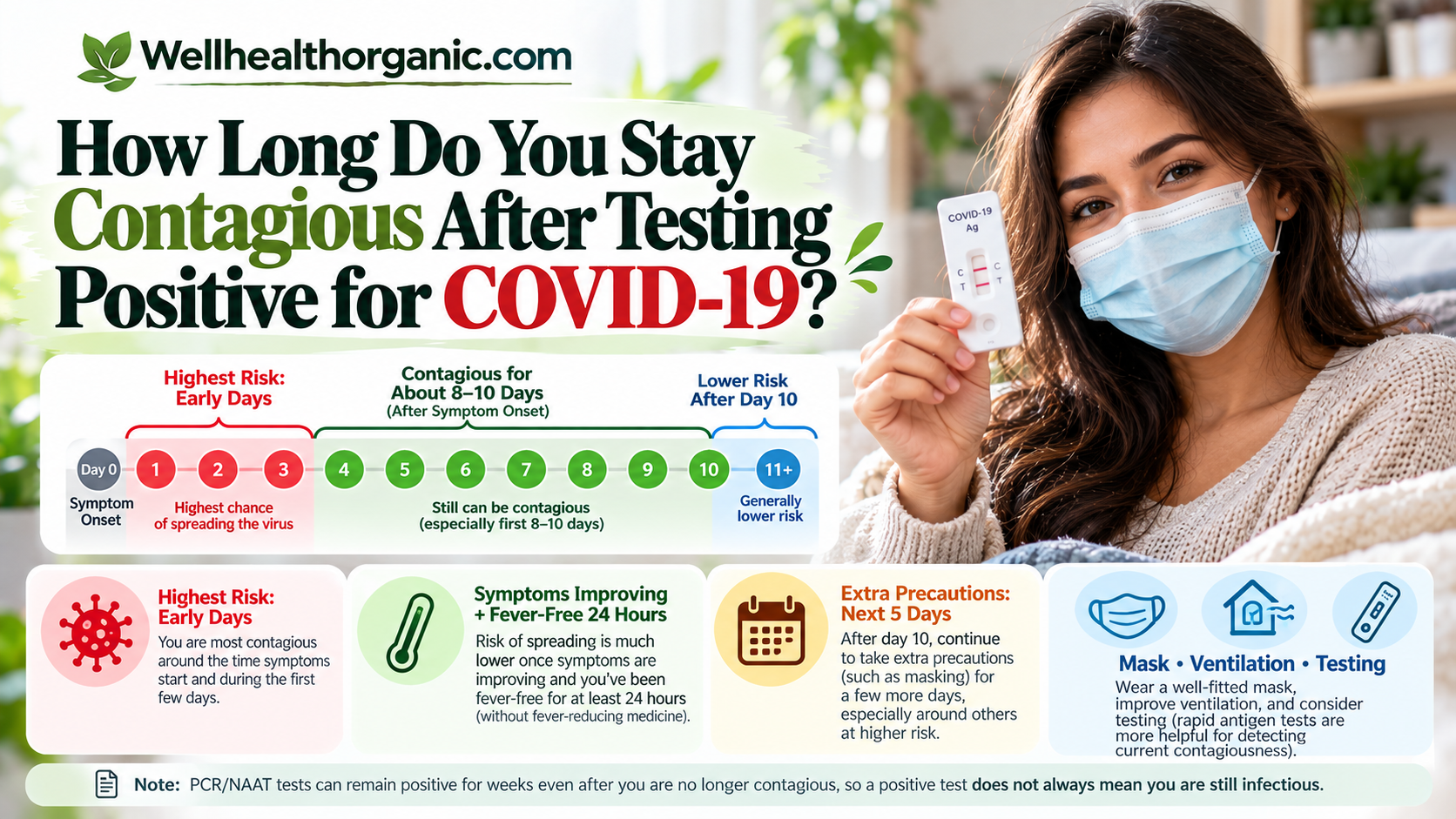
Current public-health guidance focuses less on counting a fixed number of isolation days and more on symptoms and recovery. In general, if you have respiratory-virus symptoms, you should stay home and away from others until your symptoms have been improving overall for at least 24 hours and you have been fever-free for at least 24 hours without using fever-reducing medication.
After returning to normal activities, additional precautions for the next 5 days can help reduce the chance of spreading the virus to others.
This article explains how COVID-19 contagiousness works, when you may be most infectious, what a positive test means, when to resume normal activities, and how to protect other people.
How Long Are You Contagious With COVID-19?
The contagious period varies from person to person.
People with COVID-19 can transmit the virus before they realize they are sick, while they have symptoms, and sometimes after they begin feeling better.
Rather than assuming everyone stops being contagious on a specific day, current guidance considers how symptoms are changing.
You are generally less likely to be contagious as your symptoms improve, but some transmission risk can remain after you begin feeling better.
When Is COVID-19 Most Contagious?
Transmission risk is often greatest around the time symptoms begin and during the early stage of illness.
This creates a particular challenge because people can sometimes transmit SARS-CoV-2 before they recognize that they are infected.
People without noticeable symptoms can also transmit the virus.
When Can I Return to Normal Activities After COVID-19?
For the general public, current guidance recommends staying home and away from others while you have respiratory-virus symptoms.
You can generally return to normal activities when, for at least 24 hours:
- Your symptoms are improving overall, and
- You have not had a fever without using fever-reducing medication.
This does not necessarily mean that there is zero chance of transmitting the virus.
For the next 5 days, taking additional precautions can reduce the risk of infecting other people.
What Precautions Should I Take for the Next 5 Days?
After you resume normal activities, consider additional precautions for 5 days, particularly when you will be around people who have a higher risk of severe illness.
Precautions can include:
- Wearing a well-fitting, high-quality mask
- Improving indoor ventilation and air quality
- Keeping some distance from other people when practical
- Practicing good hand and respiratory hygiene
- Using COVID-19 testing when it would help guide decisions
- Avoiding unnecessary close contact with people at high risk of severe illness
After this additional 5-day period, people are typically much less likely to be contagious, although exceptions occur.
What If I Test Positive but Have No Symptoms?
If you test positive but never develop symptoms, you may still be able to transmit the virus.
Current guidance recommends taking additional precautions for the next 5 days.
These can include wearing a well-fitting mask, improving indoor air quality, maintaining distance when appropriate, practicing good hygiene, and using testing strategically when you will be around other people.
What If My Fever Comes Back?
If you return to normal activities and then develop a fever or begin feeling worse again, stay home and away from other people again.
You can resume normal activities when your symptoms are once again improving overall and you have been fever-free for at least 24 hours without fever-reducing medication.
Then take additional precautions for another 5 days.
Can You Still Be Contagious After You Feel Better?
Yes. Feeling better does not necessarily mean that all transmission risk has disappeared.
This is why additional precautions are recommended for several days after you meet the criteria for returning to normal activities.
As recovery continues, the likelihood of transmitting the virus generally decreases.
Can You Spread COVID-19 Before Symptoms Start?
Yes. SARS-CoV-2 can be transmitted before an infected person develops recognizable symptoms.
This is known as presymptomatic transmission.
It helps explain why COVID-19 can spread between people even when nobody in the interaction appears obviously ill.
Can You Spread COVID-19 Without Symptoms?
Yes. Some infected people remain asymptomatic but can still transmit SARS-CoV-2.
A person does not need to have a fever, cough, or other obvious symptoms to be capable of transmitting the virus.
How Does COVID-19 Spread?
COVID-19 is caused by the SARS-CoV-2 virus and spreads primarily through infectious respiratory particles released when an infected person breathes, talks, sings, coughs, or sneezes.
These particles can vary in size and can remain in the air, particularly in indoor environments with inadequate ventilation.
Transmission is more likely when people have close or prolonged contact, especially indoors.
Is COVID-19 Airborne?
SARS-CoV-2 can spread through infectious respiratory particles in the air.
Risk can be higher in:
- Crowded indoor environments
- Poorly ventilated rooms
- Close-contact situations
- Situations involving prolonged exposure
Improving ventilation, using appropriate air filtration, spending time outdoors when practical, and wearing well-fitting masks can help reduce exposure.
Can You Get COVID-19 From Surfaces?
Surface transmission is possible, but COVID-19 transmission is primarily associated with exposure to infectious respiratory particles.
Good hand hygiene remains useful, particularly before eating or touching your face, but excessive disinfection of every object is generally less important than reducing respiratory exposure and improving indoor air quality.
What Does Viral Load Mean?
Viral load broadly refers to the amount of virus present in a sample or within an infected person’s respiratory tract.
Higher amounts of infectious virus can increase the opportunity for transmission, but contagiousness cannot be determined from symptoms or a routine diagnostic result alone.
Behavior, ventilation, duration of contact, immunity, and other factors also affect whether transmission occurs.
Does Vaccination Affect COVID-19 Contagiousness?
COVID-19 vaccination is primarily important for reducing the risk of severe disease and its complications.
Vaccinated people can still become infected with SARS-CoV-2 and can transmit the virus.
Therefore, vaccination status alone should not be used to determine whether someone with an active infection is contagious.
Can Different COVID-19 Variants Affect Transmission?
Yes. SARS-CoV-2 continues to evolve, and different variants can have different characteristics, including transmissibility and ability to evade existing immunity.
This is one reason public-health recommendations can change over time as the virus, population immunity, vaccines, treatments, and scientific evidence evolve.
COVID-19 Contagiousness During Different Stages
Presymptomatic Stage
A person may transmit COVID-19 before noticeable symptoms develop.
This means waiting for obvious symptoms before taking precautions cannot prevent every transmission.
Symptomatic Stage
People can transmit the virus while experiencing symptoms such as:
- Fever or chills
- Cough
- Sore throat
- Congestion or runny nose
- Fatigue
- Headache
- Muscle or body aches
- Shortness of breath
- Changes in taste or smell
- Nausea, vomiting, or diarrhea
The presence or absence of one particular symptom cannot reliably determine whether someone is contagious.
Recovery Stage
As symptoms improve, contagiousness generally declines.
However, a person may still be capable of transmitting the virus for some time after feeling better, which is why temporary additional precautions remain useful.
Does a Positive COVID Test Mean You Are Contagious?
A positive COVID-19 test means the virus or viral material was detected and indicates a current or recent infection.
However, the meaning depends partly on the type of test.
A positive rapid antigen test tends to suggest that transmission may still be possible at the time of testing.
A positive PCR or other nucleic acid amplification test does not necessarily mean that a person remains contagious because these highly sensitive tests can detect viral genetic material after the period of active infectiousness has passed.
Can a PCR Test Stay Positive After You Recover?
Yes. PCR and other nucleic acid amplification tests can remain positive for a considerable period after an infection.
Some people can continue to test positive on these tests for up to approximately 90 days.
This does not mean they remain contagious for 90 days.
For this reason, PCR testing is generally not used by itself to determine whether a recovered person is still infectious.
What Does a Positive Rapid Antigen Test Mean?
Rapid antigen tests detect viral proteins.
If an antigen test remains positive during recovery, it can indicate that you may still have a greater likelihood of transmitting the virus than someone whose antigen test has become negative.
Testing can therefore provide additional information when deciding how cautious to be around other people.
Does a Negative Rapid Test Mean You Are Definitely Not Contagious?
No test provides a perfect guarantee.
Rapid antigen tests are less sensitive than PCR or other nucleic acid amplification tests, particularly when the amount of virus is low.
A single negative antigen result does not always rule out COVID-19 infection.
When testing for infection, repeat antigen testing may be recommended depending on whether symptoms are present and the reason for testing.
Can You Be Contagious for More Than 10 Days?
Yes, some people can remain infectious longer than others.
This is more likely to be relevant in people with severe illness or certain conditions that significantly weaken the immune system.
People who are moderately or severely immunocompromised may shed infectious virus for an extended period and may require individualized medical guidance.
COVID-19 and Weakened Immune Systems
People with moderate or severe immunocompromise require additional consideration because their bodies may take longer to control the infection.
This group can include some people receiving cancer treatment, certain transplant recipients, and people taking particular immune-suppressing medications, among others.
If you are significantly immunocompromised and test positive for COVID-19, contact your healthcare professional for individualized advice regarding treatment and how long to take precautions.
Severe COVID-19 and Contagiousness
People who develop severe or critical COVID-19 can sometimes remain infectious for longer than people with mild illness.
People who have been hospitalized or severely ill should follow the instructions provided by their healthcare team rather than relying solely on general advice intended for uncomplicated community infections.
Healthcare Settings Have Different COVID-19 Rules
General public guidance should not automatically be applied to hospitals, clinics, nursing facilities, and other healthcare environments.
Healthcare settings use specific infection-control guidance because patients may be particularly vulnerable and transmission consequences can be more serious.
Healthcare workers and patients should follow the policies applicable to their facility.
Should You Isolate for Exactly 5 or 10 Days?
For the general public, current guidance does not require every person with COVID-19 to follow the old fixed 5-day or 10-day isolation rule.
Instead, the decision to resume normal activities is based primarily on overall symptom improvement and being fever-free for at least 24 hours without fever-reducing medication.
Additional precautions are then recommended for 5 days.
Specific settings, employers, healthcare facilities, schools, or local health authorities may have additional requirements.
Should You Wear a Mask After COVID-19?
A well-fitting mask can reduce the amount of infectious respiratory material released into the environment and can also provide the wearer with some protection from inhaled particles.
Masking is particularly useful during the 5-day precaution period after returning to normal activities and when spending time around people at increased risk of severe illness.
Respirators and high-quality masks that fit closely to the face generally provide better protection than loose-fitting masks.
Improve Indoor Air Quality
Because COVID-19 spreads through respiratory particles, cleaner indoor air can help reduce transmission.
Depending on the environment, useful measures can include:
- Opening windows when practical and safe
- Increasing outdoor-air ventilation
- Using appropriate air filtration
- Using portable air cleaners where appropriate
- Moving gatherings outdoors when practical
Ventilation is particularly valuable in crowded indoor spaces.
Protect People at Higher Risk
Some people have a higher risk of developing severe COVID-19.
Risk increases with factors such as older age and certain medical conditions or immune-compromising conditions.
If you recently had COVID-19, consider taking additional precautions before spending prolonged time in close contact with someone at increased risk.
When Should You Seek COVID-19 Treatment?
COVID-19 treatments are available for some people who have an increased risk of developing severe disease.
Timing is important because antiviral treatment generally needs to begin within the first several days after symptoms start.
If you are older, immunocompromised, or have other risk factors for severe COVID-19, contact a healthcare professional promptly after symptoms begin or after receiving a positive test rather than waiting to see whether the illness becomes severe.
When Is COVID-19 an Emergency?
Seek emergency medical care if you develop severe or concerning symptoms.
Possible emergency warning signs include:
- Difficulty breathing
- Persistent chest pain or pressure
- New confusion
- Difficulty waking or staying awake
- Blue, gray, or unusually pale lips, skin, or nail beds
This is not a complete list. Seek urgent medical attention whenever symptoms appear severe or life-threatening.
Can You Get COVID-19 Again?
Yes. Previous COVID-19 infection does not provide permanent protection.
Reinfection can occur, including within a relatively short period after a previous infection.
Changes in circulating variants and declining immunity over time can contribute to reinfection.
Can You Test Positive Again Within 90 Days?
Yes, but interpreting the result can be complicated.
PCR and other nucleic acid amplification tests can remain positive for up to approximately 90 days after an earlier infection, making it difficult to determine whether a positive result represents residual viral material or a new infection.
Antigen testing may therefore be preferred in certain circumstances after a recent infection.
What If Symptoms Return After COVID-19?
If you begin feeling better and then develop fever or worsening symptoms again, stay home and away from other people.
Returning symptoms can have several explanations and may require medical evaluation, particularly if they are severe or you are at increased risk of complications.
How to Reduce the Risk of Spreading COVID-19 at Home
If you are sick and share a home with other people, several measures can reduce exposure.
- Stay away from household members when practical.
- Wear a well-fitting mask when close contact cannot be avoided.
- Improve ventilation and indoor air quality.
- Cover coughs and sneezes.
- Wash or sanitize your hands regularly.
- Avoid prolonged close contact, particularly with vulnerable household members.
Perfect separation is not possible in every household, so combining several precautions can be useful.
How Long Do You Stay Contagious After Testing Positive for COVID-19? The Bottom Line
There is no universal number of days during which every person with COVID-19 remains contagious.
For people with symptoms, current general-public guidance focuses on staying home until symptoms have been improving overall and fever has been absent for at least 24 hours without fever-reducing medication.
After returning to normal activities, use additional precautions for the next 5 days because some transmission risk can remain.
If you never develop symptoms but test positive, take additional precautions for 5 days because you may still be contagious.
People with severe illness or significant immune compromise may remain infectious for longer and should obtain individualized medical guidance.
Conclusion
Understanding how long you stay contagious after testing positive for COVID-19 is more complicated than counting a fixed number of days from a positive test.
COVID-19 can spread before symptoms appear, while symptoms are present, and for some time during recovery. The likelihood of transmission generally decreases as symptoms improve, but it does not immediately become zero.
Stay home while you are actively sick. When your symptoms have been improving overall and you have been fever-free without fever-reducing medication for at least 24 hours, you can generally resume normal activities while taking additional precautions for another 5 days.
Testing can provide additional information, but remember that a PCR test may remain positive long after the period when you are likely to be infectious.
People who are severely ill, significantly immunocompromised, or at increased risk of severe COVID-19 should seek individualized medical advice.
Frequently Asked Questions About COVID-19 Contagiousness
How long are you contagious after testing positive for COVID-19?
There is no exact period that applies to everyone. Contagiousness generally decreases as you recover. Current general-public guidance recommends staying home until symptoms are improving overall and you have been fever-free without fever-reducing medicine for at least 24 hours, followed by 5 days of additional precautions.
Are you still contagious after 5 days?
It is possible. Some people can still transmit the virus after 5 days, which is why symptoms, recovery, testing, immune status, and additional precautions are more useful than assuming everyone becomes noncontagious on the same day.
Are you still contagious after 10 days?
Many people are much less likely to be contagious by that point, but there are exceptions. People with severe illness or significant immune compromise can remain infectious for longer.
When is COVID-19 most contagious?
Transmission risk tends to be particularly important around the beginning of illness, including shortly before and after symptoms begin.
Can you spread COVID-19 before symptoms appear?
Yes. Presymptomatic transmission can occur, meaning an infected person can spread SARS-CoV-2 before realizing they are sick.
Can you spread COVID-19 if you have no symptoms?
Yes. People who remain asymptomatic can still transmit the virus.
When can I go back to work after COVID-19?
For general activities, you can usually return when symptoms have been improving overall for at least 24 hours and you have been fever-free for at least 24 hours without fever-reducing medication. Take additional precautions for the next 5 days. Your employer, healthcare facility, or local authority may have separate requirements.
Do I have to isolate for 10 days?
Not necessarily. The current general-public approach is symptom-based rather than requiring every person to complete a fixed 10-day isolation period. Different rules can apply in healthcare and other specialized settings.
What if I test positive but don’t have symptoms?
You may still be contagious. Take additional precautions for 5 days, including measures such as masking, cleaner air, distancing, hygiene, and strategic testing when around other people.
Does a positive rapid test mean I am still contagious?
A positive antigen test can indicate a greater likelihood that you may still be able to transmit the virus. However, no single test perfectly measures contagiousness.
Does a positive PCR mean I am still contagious?
Not necessarily. PCR and other nucleic acid amplification tests can remain positive for weeks and sometimes up to approximately 90 days after infection because they can detect residual viral genetic material.
Can I still be contagious if I don’t have a fever?
Yes. Absence of fever alone does not prove that you cannot transmit COVID-19. Overall symptom improvement and additional precautions should also be considered.
Can I be contagious if I only have mild symptoms?
Yes. People with mild COVID-19 can still transmit SARS-CoV-2.
Can vaccinated people spread COVID-19?
Yes. Vaccinated people can still develop COVID-19 and transmit SARS-CoV-2, although vaccination remains important for protection against severe disease.
Can immunocompromised people stay contagious longer?
Yes. Some moderately or severely immunocompromised people can remain infectious for considerably longer and should receive individualized medical guidance.
Can I get COVID-19 twice?
Yes. Reinfections can occur, including within 90 days of a previous infection.
Should I wear a mask after recovering from COVID-19?
Wearing a well-fitting mask is one of the additional precautions that can reduce transmission during the 5 days after you return to normal activities.
How do I protect my family if I have COVID-19?
Stay away from other household members when practical, improve ventilation, wear a well-fitting mask during unavoidable close contact, practice good hygiene, and take particular care around people at increased risk of severe illness.
When should I contact a doctor after testing positive?
Contact a healthcare professional promptly if you have risk factors for severe COVID-19 because antiviral treatment may need to begin within the first several days of symptoms. Seek emergency medical care for severe breathing difficulty, persistent chest pain or pressure, new confusion, inability to stay awake, or other serious symptoms.
Disclaimer
This article is for general educational and informational purposes only and does not replace medical advice, diagnosis, or treatment. COVID-19 recommendations can change as scientific evidence and circulating variants evolve, and different guidance may apply in healthcare facilities or other specialized settings. Follow current recommendations from your local public-health authority and seek individualized advice from a qualified healthcare professional if you are severely ill, immunocompromised, pregnant, at increased risk of severe COVID-19, or uncertain about when it is safe to resume normal activities.